Thursday, August 19, 2010

Contest Among Wolves


Motorcycle Diaries
Walter Salles
Brazil
2004


"Man truly achieves his full human condition when he produces without being compelled by the physical necessity of selling himself as a commodity."
— Che Guevara, Man and Socialism in Cuba


All roads lead to the heart—a premise Walter Salles used for his 1997 film “Central Station” and has been doing continuously to most of his films. Depicting the time when famous revolutionist Ernesto “Che” Guevarra traveled South America which according to him he only knew in books with his friend Roberto de la Serna, the director ultimately expanded the distance his characters are voyaging. In “Central Station” the journey takes place within Brazil whereas in “Motorcycle Diaries”, we are taken into a humbling immersion from Argentina to Chile, to Peru, and Venezuela. Thus creating a tremendous force that will shake the world’s political philosophy yet at the time latent in the soul of Che Guevarra, the film still position the immensity of the character’s potent into a more personally connecting height.

I really don’t know much about Che Guevarra though I sometimes see his printed face on some shirts my schoolmates in college are wearing. And once or twice I’ve heard his name from few friends telling that he is a communist leader. That for no any excuse penciled in some sketches of an old man in some shabby clothes and untidy beard—in other words, an unlikable man. Probably one of the biggest surprises in my life is to see the youthful Che Guevarra and get swept away by a charismatic portrayal in the film by Gael Garcia Bernal. That must be the first and most apparent good thing about the film. Bernal is arguably the most famous Mexican actor internationally. I have watched a couple of his major movies—“Y Tu Mama Tambien”, “Babel”, “Amores Perros” and excluding “The Crime of Father Amaro” which I have long wanted to see, this is by far and by a hundred mile the best Gael Garcia Bernal I have ever witnessed. It is definitely one of those few moments where you can say that an actor is born to play such role. The recipe is simple; an internationally acclaimed Brazilian director making a film about a historical and internationally influential figure will cast no less than a big name such as Gael. Bernal’s charisma is significantly bountiful to depict such a character like Che Guevarra. I love the fact that while most of his movies are coming-of-age ones which are characterized by gambling, sex, and the happy-go-lucky personality, this is where his character has developed the most while still engaging in the free-spiritedness of his usual roles. 


To see Che in the historical Cuban Revolution is synonymous to watching Frost/Nixon and JFK—in some other words, uninterestingly austere and obnoxiously old. I have not seen those two films yet and I know it’s not fair to say what I said about them but those are what keeping me from making any efforts to watch the two. “Motorcycle Diaries” is not about the sober revolutionist Che instead the young Che in his motorcycle, loving a woman, having fun with some other woman, drinking wine, dancing Tango and Mambo, writing notes on his diaries as his groundbreaking material unfolds. For many times Che claims that the travel they embarked on is aimless however, I don’t find it absolutely true—they have always wanted to help in the advancement of medicine and treatment of the needy. This vaguely distinguished element causes an elementary perplexity in the narrative. The soliloquy of Che mostly at the end part and the over-all treatment of the film support the feeling that Che has found a new passion—something he wants to pursue. And because the film sculptured the narrative with declarations about the aimlessness of the travel and the implicitness of the medical objective, the perceptible transformation Che undergoes seems to be attributed to the goal he has always had from the start. The change the protagonist experiences is his unexpected empathy to the poor and not to the sick because again, his empathy to the sick has always been there. The film could have been more effective and have shown more form through working on the contrast and similarities had the film emphasized that difference between Che’s stance to the sick and Che’s stance to the poor.

The second best thing about Salles’s work is that it is enormously engaging and charming. Accounting all the allure to Gael is of course an exaggeration for the director cunningly represented the character and the adventure in a mutual and fair balance—never the character did overrun the adventure nor the adventure did overrun the character—a friendly combination of a character-driven and a plot-driven story I can say. The events and the places Ernesto and Roberto have been are equally treated plot-wise and narrative-wise. Even the travel by the boat from one place to another has provided a lot of fleshing out of the characters. We see and know them better from every point in their journey. The guileless and profound relationship between the two is adorable, most of the time funny and more importantly—secured. The relationship though between Ernesto and the patients and the rest of the community in the hospital can not be underestimated but perhaps because of its less plot time relative to his adventures with Roberto I feel that the main source of heart in the film is the adventure of the two more than the doctor-rich-privileged and patient-poor-unprivileged affiliation. The later can be the main source however of inspiration for Che himself.


The film is highly patriarchal. I am not sure if it is appropriate to talk about feminism here but it feels so masculine from start to finish. The motorcycle alone is an exceedingly masculine symbol. Their demonstrated flair about women whether Argentine or Chilean adds to it, plus the gun given to Ernesto from his father. Che and Roberto are also highly educated being a graduating medical student and a biochemist respectively. All of their qualities are so asymmetrical to the women in the story. Women are being left, being fantasized, to some extent being sweetly taken advantage; some are reduced to being dance partners, and the worse—being sick, and the worst—being treated by a no less than male doctor. Somewhat and somehow it contributes to the notion that men are the foundation of new ideologies and courageous resistance.

Che conceives a unity for all Latin and South Americans, all people from Mexico all the way down to Magellan strait. Visually this is reflected in the film. The travel took place in at least four different countries and yet the treatment from one place to another is consistent. While it is a common practice in filmmaking to consciously delineate a place to another, “Motorcycle Diaries” consciously unifies those Latin countries, at least visually. The most breathtaking scenery in the film would be the remnants of Inca civilization and even more breathtaking is Che’s realization of how can an empire capable of doing such marvel be swept out to extinction. The most allegorical scene on the hand would be the one where Che after giving a speech on his birthday celebration decides to cross the river which caused a lot of panic to the people shouting at him to swim back for no one has ever crossed that river yet especially on a cold midnight. The nurses and the other superior people on the other side of the river and the more ordinary people on the further cheering for Che to make it symbolizes his foreseen struggle to alleviate inequality.

“Motorcycle Diaries” is a worthwhile movie. Truly a threshold of understanding the famous Che Guevarra in his infamous time, the film gets so thrilling with the most human adventures and so endearing with unsaturated nostalgia. If the purpose of this film is to demonstrate a likeable person against someone who is solely an enemy of capitalists, then I commend the film. Now I can comfortably say that in any case I will take any further reading about Che the only prejudice I will have are the encouraging ones.


Saturday, August 14, 2010

There’s No Place Like Home


Up in the Air
Jason Reitman
USA
2009


For him, the air is his home.

In general, I am not a fan of movies based on fiction or novel, or short stories. Literature and film are different media that create dissimilar experiences of art. Almost all of the people I know always say that the book version is better than the film and at extreme and more usual cases that the movie murdered the book. My response would be diplomatic, considering the fact that books and movies are two different practices and along the production of a film comes more than a hundred of cinematic to economic oriented decisions accounting to diversions from the book with of course varying extents. It is undeniable though that there have been a number of great films with adapted screenplays—“Slumdog Millionaire”, “Brokeback Mountain”, “Memoirs of a Geisha” and also undeniable is the fact that there are also disappointing ones. A wonderful book acclimatized to a film will become one that is geared toward the character’s highfaluting and staggering philosophy or campy whimsicalities and the challenge that will confront the director will be the kind of form he will structure the novel. In “Doubt”, the director decided to be minimalist which really many directors would opt to as in a way a kind of preserving the highly-character oriented substance of a book. The most practical and sensible use of this art’s quest for a different medium would be that of a sci-fi or fantasy novel. At least in the popular culture, this is hugely evident like that of “Lord of the Rings”, “Harry Potter”, and “Twilight”. One of the few moments I am seriously gratified by this shifting of media aside from LOTR trilogy and Harry Potter series is David Fincher’s “The Curious Case of Benjamin Button”. This type of story is one of those who don’t just need to be visual (for all stories ask for its reader’s imagination) instead needs an extreme and arduous visual treatment and interpretation. 

 The many contrast between Bingham and Keener-age, gender, body built, and beliefs still provide a charming chemistry between the two.

The director of Academy Award nominated “Juno”, Jason Reitman comes back with a film adaptation of “Up in the Air”. I wish I have read the foundation novel before I write this but I find the film too overwhelming to contract time. My professors say that a brilliant screenplay even handled by a mediocre director would still result to a brilliant film but a bad screenplay even handled by a Francis Ford Copolla or an Akira Kurosawa would result to no more than the worst works in their entire filmography. The film is script-wise astounding; in fact, I believe almost entire of the film’s compelling force is due to it. Conversely I can not deny the fact that Reitman did not try to make it look so much of a novel-based movie. The director manage to engage playful cuts, independent cutaways, and purposeful and at the same time resourceful montage which is not a normative standard of movies. The rest is not unnecessarily radical nor in any case tries to be a powder keg of a new novel to book filmmaking guidelines. Instead, what he does is a prudent and innovative delivery of making a novel into a cinematic template that is efficiently persuasive of itself as a film and not anymore of any medium. He achieves it by a spanking youth in technical (at least in editing) manipulation and in general transformation of an already fulfilling fiction into a film fit screenplay.

I believe that in any extent Reitman did influence the qualitative amount of interweaving elements from the novel to the film. It is also not too far from believing that he wanted to create more sense of contrasts and variation which is truly commendable because that is the most faithful to the form of cinema that you can do to translate a content from other media.

An amalgam of character-reflective metaphors, character and philosophy clash, dynamic swing of wane and recreation of them, far-fetched twists, and tons of intelligence covered with collected wit describes this stirring tale of life with relationship, dream, and passion at the core. Ryan Bingham (George Clooney) works as an employment sheriff. He travels all year long from different cities in the country—Omaha, St. Louis, Wichita, Tulsa, San Francisco, and a lot more. With his new co-worker who is trying to revolutionize their traveling work into a more cost-efficient virtual termination of employment, Ryan is tremendously displeased with her scheme so gearing to the business while directing away the serious psychological effect of the terminated workers which Ryan believes will only be reduced with a person to person communication. There are a lot of differences between Ryan and Natalie Keener (Anna Kendrick) however it is a joy not see them take it personally. The occurrences where the two are together talking about life and how they argue with their definitions and standards are very exciting. Appealing also is the fact that neither one of them has been favored by life ahead of them. Even Ryan, the main protagonist doesn’t hold the claim of truth or his philosophy as the superior or his beliefs as the closer to life itself, nor does Natalie. Both of them are proven wrong and right at some points by the other. I also find the double twists so enhancing of the watching experience. Ryan decides to follow Alexis and have a chance to have the wife and family he never wanted and then learn that Alexis already has a husband and kids. Few scenes before that, we see Ryan and Alexis having so much of times that conceive a future wedding of their own.Natalie also at the late part of the film seems to have won with her virtual termination scheme and then later on decides to quit the job after learning that a previous terminated employee committed suicide. These twists and twists again crisscross from the two or three main characters in the film structuring an interesting and intricate body of complimenting rudiments. 

 Ryan's sister asked him to take a picture out of cardboard of her and her husband in the places Ryan visits.
This is a metaphor of Ryan's incredulity about marriage.

The worst thing the director could ever do in this film would be appointing actors who will fail to bring these characters with the most ostentatious and rigid words out of their mouth to come to life. It is legal for “Doubt” to brag about the acting component of the film as Meryl Streep, Philip Seymour Hoffman and Amy Davis just did not do anything wrong about their assignments. Following such tradition, George Clooney together with supporting role players Vera Farmiga and Anna Kendrick does a performance so provoking, so pounding like a hammer and most importantly so grasping of empathy. At this point in time of Clooney’s career I never expected anything this appropriate a role for him as much as I don’t anticipate any role that will re-launch the 12-year starvation of Tom Hanks’ career.

“Up in the Air” is one of the most, if not the most engaging Hollywood film last year. Though it is easy to have such riveting nature adapting a screenplay from a novel of Walter Kirn, the film is a satisfying success for its deeply nurturing temperament becomes an experience of lyrical consciousness. It made me feel so alive.

Tuesday, August 10, 2010

I Love You, 10 or 11 Times More

Paris, I Love You
Various Directors
France
2006


“Paris, I Love You”, the film in English translation is a luscious and enticing splatter of 18 pleasant short films about different pairs of lovers in different occasions, forms, age, sexuality, religion and nationality all in one romantic city called Paris. 18 seemingly unrelated short films are edited together and the final cut is a sweet, delightful and mesmerizing vignettes of love as the most universal concept the history of mankind has ever known. With over a dozen of directors from the vanguard of contemporary cinema, the film soars captivatingly high as the extremely popular romance drama has been elevated to the pedestal of great films still retaining the mush in its seducing and tantalizing authority without ever, not even a single second, letting the viewer remind them of the synthetic mush popular cinema has been feeding its skeptic and/or hopeless romantic audiences.

The following are the 18 short films comprising the lovely “Paris Je T’aime” (in exact order as they appear on the film)

1. “Montmartre
A man ranting about him being alone when everyone in Paris is with someone finally meets someone.


The first course to this extremely fine dining unlocks the beginning of all the love stories ever—the first meeting. It establishes the worldwide notion of Paris as a lover’s city when the man notices that he is alone in the city and even affirms it when he finally sees one. A simple yet effective way to start the film and would even be more effective after we draw its contrast with the final part at the end. The creativity in shots is also noticeable in “Montmartre”.

2. “Quais de Seine”
A French college boy studying history sees the hidden beauty of a Muslim college girl studying Journalism.

College is one of the most romantic age the modern lover’s cinema has witnessed. I love the fact that with the help of cultural diversity in a contemporary city takes over the generics of this type of love story. The Muslim college girl is indeed beautiful and it’s not hard to believe in what the college boy sees on her. I also love the French sun mellowing Caucasian skin and sensationalizing that of an Eastern skin.

  3. “Le Marais” by Gus Van Sant
An artist feels the urge to talk to someone he thinks is his soul mate. 

Seeing Gaspard Uliel again will be enough to watch this film, after his impressive portrayal of the young Hannibal Lecter in Hannibal Rising. This may not be the most outstanding of all Gus Van Sant works, probably because of the little time he has. However the director is still able to cover this short film with the same mystifying force we have seen from his Cannes Festival winning film “Elephant” and introduce the character in its best effort to direct a very personal, almost inexplicable, sensitivity to someone nothing really more than a stranger.

4. “Tuileries” by Joel & Ethan Coen
An American traveler learns to avoid eye contact to people standing around in the Paris Metro.
 
Seeing Steve Buscemi in something like this is not surprising, instead satisfying. Twice the satisfaction is the Coen brothers comic genius in this tourist-local cultural-oriented conflict. “Burn After Reading” remains to be the closest to perfect comedy film at least for me from the brothers though this one is of course worth the watch.

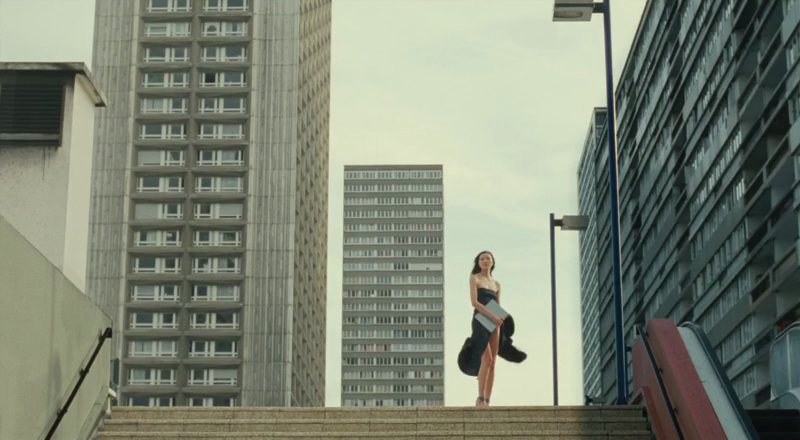
5. ”Loin de 16e” Walter Salles & Daniella Thomas
A mother leaves her baby to the public nursery to go to her baby-sitting job.

 Walter Salles utilizes transportation again as a mean of magnifying a distance between two worlds. If you remember his Academy Award winning film “Central Station”, its premise—all roads lead to the heart—is still applicable to this one. Looking too mundane and shallow is my first impression but if you have watched the director’s other films, you will definitely incur more sense about this short starring the stunningly beautiful Catalina Moreno.

6. “Porte de Choisy”
A sales man comes to a Chinese beauty parlor to introduce their new products.
 
Tricky and surreal, it definitely borrows the narrative aesthetic of early French experimental films. Aside from the dazzling cinematography, such as the shot above, the film is rich with remnants of French film history expanding from Post War art movements to Orientalism era and its marriage by the timeless concept of love.

7. “Bastile”
A husband planning to leave his wife learns of her terminal disease and all the love lost through time has been found.
 
A heartbreaker I didn’t see coming, this part is a recreation of love. Unlike the previous shorts which are about the exhilaration of love at first sight, this one is already a dozen of steps ahead. Just passed the stage where love almost died and that is later redeemed by the awareness of a nearing death.  A man in love is a sweeping picture, with this one, when the man possesses the endurance mostly only women can handle and it doubles the empathy the husband is receiving from the audience. Undeniably, it is one of the best among the 18.

8 “Place des Victoires”
A mother grieves for the death of her son finding strength from a transient moment with her son again.
Carrying over the death from the preceding short, this one deals with the after death. Juliette Binoche stars as a mother who just lost his son. The mother is devastated, almost insane, which I am in favor because it displays Binoche’s caliber. The hallucination scene which I always attribute to the French New Wave is a little over-designed, and its transience reflects the mother’s transient recovery from the loss. An almost dying mother in denial, anger, and grief passed all the way to acceptance in just a matter of minutes (whether plot time or running time). That is too hard to have it work in a less than 10 minute-short film.

9. “Tour Eifel
A young boy tells the love story of his mime parents.
 
The reverence for the early 20th century film French entertainment—pantomimes, brings along the magic of silent films and some American romance films in Paris (Audrey Hepburn films) and the supposed pleasure and cuteness of mimes in modern Paris as told be their adorable son. This film realizes the big cross of vanishing pantomime golden days that their children bear.   

10. “Parc Monceau” by Alfonso Cuaron

11. “Quartier des Enfants Rouges”
A drug user finds a drug pusher supplying her another drug—love.
This short is vulnerably daring as any film with drug-addiction themes can get. I haven’t really seen any movie with such theme that has really brought the subject matter’s darkness into enlightenment. I am not looking at character’s redemption, what I am looking for is a cinematic template that fosters the darkness of drug addiction into a pleasantly consumable experience. “Trainspotting” is not even close; “Manila” is also not, as well as this one.  I don’t think a love story as unceremonious as this one would even reach Step 1. Conversely, the oddness between these two people will be beneficial for the next short and contributes hugely to the over-all coherence of the film. 

12. “Places des Fete”
A rescue volunteer has the coffee on her hands but the man wishing for it together with her just died. 
Absolutely, another one of the best in the roster of 18, this short film is another heartrending one. A volunteer tries to rescue a stabbed man, during the course, the man asks her whether she remembers him making the woman surprised. It cuts back to an earlier scene where the man is revealed to be a janitor in a parking lot where the woman is working. Before the woman finally leaves the lot, the man tries to ask her for a coffee, to bad she is too far already to hear it. With the man humming the same song the day they met on the parking, the woman recognizes him. Back on the rescue operation, the female volunteer asks for two cups of coffee. But few seconds before the two cups of black coffee would come, the man is declared dead.
The flashbacks in this film works good though I don’t think it is already on its 100% mark. Some information could have been placed somewhere else and there is also a POV shot at the start that doesn’t conform to the succeeding shot but even though I have these comments I can’t stop myself from getting drawn to this one because content-wise and structure-wise it is a knock-out. Continuing with the “oddness” I mentioned above, this is the first time I felt that something is done to surmount that mountain standing between two lovers.

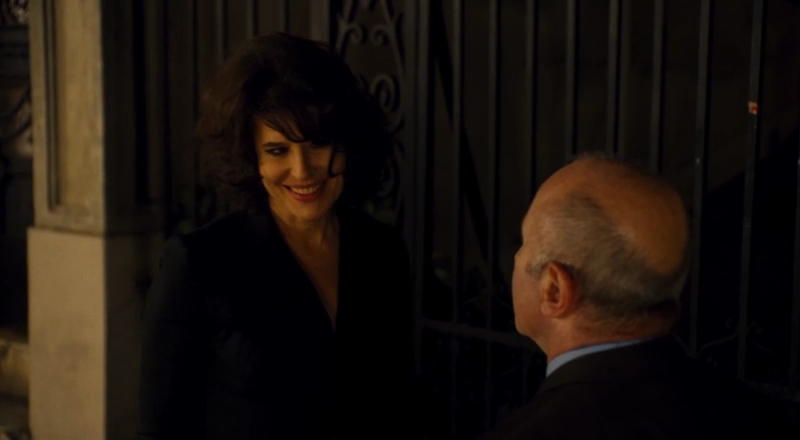
13. “Pigalle”
Wise exchange of dialogues, canny similarity and differences between today’s culture and the characters’ culture of their prime years, this one is as witty as most French films are. Except for some weird feelings of being obliged to love the characters and their resentments, this part is generally one of the most French among others.  

14. ”Quartier de la Madeleine”
A traveler sees a vampire and falls in love with her.
This one is a stand-out, combining the famous horror genre and love story with an overflowing metaphor from start to finish. An explorer to Paris witnesses a vampire sucking fresh human blood. He falls in love with her and cuts his pulse for her to suck but the woman vampire seems to care about the guy not to be like her though it is obvious that she like him. Having cut his pulse, the explorer fell of the stairs and loses a lot of blood. The vampire on the rescue bits herself and replaces the man’s blood with her own. Thus, inevitably making him a vampire like her, the two are now of the same kind.
Elijah Wood is a little typecast for this short film but it is a huge delight to see him not a Frodo but someone else. The genre is highly dynamic, so classic with American famous horror genre of the 60s or 70s, German horror films of the Pre-War, and also some elements of Hollywood noir—the insanely red color of the blood perhaps. The film is rich from start to finish I don’t think there is anything in the short that has no use--the stairs he is climbing at the start is also the stair he fell upon at the end, the motorcycle where he hides probably is the victim’s ride. The metaphor of lovers’ difference is their vampire-human difference, and not just that there is an effort to surmount that, this is the first time that such disparity has been gone 

15. “ Pere Lachaise” by Wes Craven

16. “Faubourg Saint-Denis” by Tom Tykwer
A blind young man receives a phone call from his girlfriend breaking up with him and remembers their love story.
This scene reminds me so much of the director’s earlier phenomenal film “Run Lola Run”. I see this part as more of a possible continuation of the preceding short—where they are able to outdo the lovers disproportion but ends up realizing that a romance should be over. The short is fast-paced not only pointing to the intertextual personality of the director he is applying to his film but also because of the ostensibly fast-paced love story between the two. The montage at the middle to late part is very interesting as it significantly coheres to the over-all behavior and bravura of the film.

17. “Quartier Latin”

18. “14e Arrondisement” by Alexander Payne
An American traveling by herself discovers an unprecedented feeling she has never yet felt. 

This part is the main attraction and yes, the best, and the most consolidating of all. An old maiden traveling in her long-dreamt city—Paris, sees the beauty of solitary eating, walking, watching, and living. She walks to places visited by people with companies, eats where everyone eats with family or friends and contemplates the could-have-been in her life. Until one day while sitting on a park with her sandwich, a sudden feeling came through her, a feeling of joy and sadness, of sadness brought by something missing in her life, and for the first time in her life—she feels so alive. That’s the time she knows she has fallen in love with Paris, and Paris has fallen in love with her.
Going back to the beginning of the 17 shorts, this final short has already stopped from looking for someone to love. What makes this one extremely poignant is the beautiful shape-shifting deviation from love with someone to love with something, or to somewhere instead. The short is captured vividly and as alive as the main character’s realization. Nothing less than a chicken soup for the soul, this short film add another groundbreaking definition of the world’s greatest subject matter—love in the location most renowned for its loveliness—Paris.

Wednesday, July 21, 2010

My Wong Kar Wai Experience

In The Mood For Love
Wong Kar Wai
Hong Kong
2001


During my sophomore year at the film school, I used to ask my fellow film students about their favorite films ever. Asking them to list at least 10 of their favorite movies, “Eternal Sunshine of the Spotless Mind” was the most common entry among the lists I’ve gathered. Aside from that surprise for I thought that Jim Carrey-Kate Winslet movie is nothing really special than a little above average break-up film of science and romance fiction, Wong Kar Wai films were also present in most of the list. It is right to say that Wong Kar Wai was, at least at that time, our batch’s favorite director.  Out of shame for not seeing any of his films, I started to have a Wong Kar Wai expedition. And I wish I could say it in a nice way but I have really been generally dissatisfied with my Wong Kar Wai experience. My fellow film students claim that it is not hard to fall in love with the director’s steamy visuals and romantic insights and I could never disagree. Yes, Wong Kar Wai has an ostentatious sense of vision and in fact they are most of the time spectacular, and I commend the Chinese director for that. However, I have always been uncomfortable with films that are overly fluid which are exactly his films. At times, you would feel so lost in his movies. It’s as if it has no backbone that would be the major support to have its structure conceivable by the audience. I understand his sentiments about lovers losing sense of times and it might have worked for many people including my classmates though I would prefer to see such films still with solid structure and clearer direction. I find his “2046” the hardest film to watch and understand because it is too cerebral, and consciously obscures fantasy and reality. Together with “Chungking Express”, Wong Kar Wai stipulates the life of a human soul in love in randomly affecting spheres of repressed feelings, misunderstood infatuation, and tainted impulse. Including “In the Mood for Love”, I’ve seen more of his technical inclinations. The director always employs tight editing. This philosophy never worked for me in “2046”, it feels so suffocating and isolating. There has been so much the film wants to shout out loud, its saturated red-orange-gold lighting and mise-en-scene could not be contained by the medium shot to close up shots in the entirety of the movie. In “In the Mood for Love” however, I found more room to breath in its tight cinematography. The two films have similar reasons of the applying such camera theme, I guess what pushed the latter film to more understanding is the fact that it doesn’t bloodily shout anything inside. In fact, “In the Mood for Love” has a gentle treatment of a love affair that is usually treated ungently. Among Wong Kar Wai’s films, “Happy Together” is the most endearing and heartbreakingly compelling. One thing I really like about this Chinese director is his courageous interpretation of unfulfilled love and it has been maximized in “Happy Together”. An aspect about the film that worked for me is that this one feels more a part of the world, it feels more attracted toward other people in the planet, whether a stranger, a fellow race, or a familiar face. This gay film has intense amount of romance, charming enough to love and conservative enough to keep its equation to notional carnal requirements. Above all else, in terms of spatial cinematography this is the most generous. Wong Kar Wai employs long distance shots to extreme long shots giving the film more relevance to the diversity of life.

 Shadows on the wall mimic a jail railing connoting the idea that these two lovers are prisoners of their love.


Focusing on “In the Mood for Love”, its self-contained gorgeousness and his use of metaphor are the film’s most triumphant weapon in the director’s arsenal. Aside from his recurring and parallel love stories, this is the director’s first direct employment of the time that has passed. This film doesn’t provide an accurate point of when the feelings between these characters started. They realized it without expecting it, and without the anticipation, and without the appropriate circumstances in their lives at that point of time, their ending would foretell a fate more indistinct than how they started. An unfulfilled love is where Wong Kar Wai finds artistic and dramatic sanctuary, and he has mastered it overtime. Woody Allen’s “Vicky Cristina Barcelona” also gave an affirmation about this—that only an unfulfilled love can be romantic. An anti love story can never get wrong. The main reason about the quest for anti love story is because of its revolutionary spirit against the happy ended love stories proliferating commercial cinema. Most of the films which involve a man and a woman that you can classify as quality, art, or award-winning are anti-love stories. What is it about humans that inclines art more to the pain, sorrow, and agony than the joy, happiness, and satisfaction? Is art an apparatus of skepticism and cynicism? Well I guess, being happy, joyful, and satisfied is too easy to bear and doesn’t need much interpretation about it or at least doesn’t find the need to interpret it, and being sad and in pain is too unbearable that we need to deeply express it. Life as we all know is a combination of the good and the bad, the pretty and the ugly, the happy and the sad, and understanding the negative ones needs more effort and seeks different media to communicate, and one medium is film.

This shot is reminiscent of the director's 1997 gay film "Happy Together.


What has also been magnified in the film is the director’s bittersweet observance of the time passed. There is a scene where after several years the main characters go back to the place where they used to be tenants and learn that most of their friends are no longer living there and even the landlady is about to move in America. After that scene, a text reads—that era has passed, nothing that belonged to it exists any more. It’s not a childhood nostalgia, but a longing that occurred in the adulthood—an adult nostalgia that is maturely bitter and serious.

Visually the film is really fantastic, as what I mentioned above “gorgeous” is the best word to describe it. I also love the smoothness of the music employed it, especially with the Spanish accompaniment of “Perhaps”. The film is not bad at all, as any Wong Kar Wai films can be. This is just a matter of personal definition of what is beautiful, significant, and competitive as a whole unit and not by parts. The last part is really heartrending. The story about the old time when they use to whisper a secret at a tree and cover it with mud will be mentioned 4 years after in “2046”. At the ancient Angkor Wat in Cambodia Mr. Chow (Tony Leung) whispers in a ruined wall to tell his love for his neighbor (Maggie Cheung). With an ancient tradition, their love story ends. 


Monday, July 5, 2010

The German Treasure


DOWNFALL
Oliver Hirschbiegel
Germany
2004


There are a hundred and perhaps even a thousand of films about the Second World War, holocaust, and anything that has something to do with probably the world’s most notorious and hated human being ever—Adolf Hitler. This film however doesn’t have its focus on the Fuhrer’s tormenting quest for world domination. It concentrates itself with Germans alone and its featured enemy, the Russians, is conceived distantly and only visually present in few necessary scenes. The usual second world war films in international arena are about the French, Italian, Russian, Japanese, American British, and Germany’s interconnected military maneuvers and tactics or about the soldier’s harrowing experiences, pain, endurance, and importantly the essence that the real heroes and at the same time victims of wars are the soldiers. Never had I really watched a film about the principal culprit of perhaps the most shattering event to occur in the history of the world. Choosing to present the collapse of his mission until his suicide instead of his advent and all the promising auspices of his German supremacy is a groundbreaking statement. Opposed strongly to Leni Reifenstahl’s documentaries such as “Birth of a Nation” and “Olympia”, this is a film that deflates all of the success and greatness Hitler may had have at those films, though Hirschbiegel is prudent enough to give elements of respect for the man who drastically shaped history in this incredible and compelling film.

Aside form the actual downfall of the nation, looking at who Adolf Hitler really was, is the most reasonable aspect to look forward to. As a person who is not a German, who is born in the relatively peaceful times 43 years after Hitler’s death, who is interested enough in history, I think of him as definitely a visionary, but his indulgence to being a German while discriminating all the rest, and the time he was born in history when other countries are as politically operational are both reasons why he can never be the world conqueror he was dreaming of. In the film, he is portrayed as someone plagued with superiority complex, lacking with compassion, especially with the civilians, the common German people outside his direct command who he even mentioned as weak. He is desperate, and in the midst of the toughest and most dire situations he seems insane. While his generals make sense about the real danger of the enemies circling Berlin, he keeps on insisting impossible tactics and order. This is not to accuse he is insane at all, his madness is not impossible to expect in anxious times but in the film itself it, all of the lunacy targets his character like a dagger. His epileptic left hand is not simply cast in Bruno Ganz acting, it also a metaphor of his unsuitability of his grand ambition. The rattling hand is a cataclysmic doom of mankind, and that same hand is his own curse, his own inevitable quagmire.


The horrendous cost of his aspiration may be enough to despise Hitler but it is undeniable that for a time, in his nation, he is the most respected. Looking at Reifenstahl’s “Birth of a Nation” he is a half-God, half-man, and as a German and even any German (If I were a German) Hirschbiegel, can’t deny it. That for a time in Germany’s most significant history, there was someone they believed, adored, and trusted, and that should be enough to give due respects to Hitler even in the most sublime way. In the film, before Hitler dies, he asks that his enemies should never see him dead. Hitler and his wife enter the door with the poison capsule and the gun, the door is shut closed, gun shots are heard. His men enter the room. Camera shows his men carrying covered body of the Fuhrer and his wife. They bring the corpses outside the bunker and place them in a 6 feet deep burrow and burn them. The brutality of their death is never existent on the film at least visually. This is the respect that the director can mostly do particularly following historical accuracies.

The film is brilliant in many ways. The subject matter itself is enough to be riveting, and with its appropriate cinematography of black to gray to olive green, its decent editing, convincing sound and music, I just couldn’t ask for more about its technicalities. I appreciate the gloomy atmosphere the film tries to keep consistent in the bunker and even outside. The manipulation shows as if sun has never risen in the soon to fall city. The scenes where Hitler’s closest and most loyal people are deciding on how to commit suicide are so moving, and when they commit the suicide just like their Fuhrer are so striking. These people would rather die than to surrender their ideologies, and there’s one thing I have realized--there is nothing like being forced to accept your death in the circumstance of losing. The only thing I wish to have been changed in the film is its claim of the secretary’s point of view. It is not true at all, the POV is everywhere. I am not a fan of POV scattering around the place but in this film, I think the unrestricted POV works. This is because these multi-possessed POVs represent the many number of people involved in that downfall. It may be as many as the real number of war victims but this is enough to know that this is not just between Hitler and his ambition. The secretary’s POV is actually useless. Even though he has some scenes where he gets to know the Fuhrer and his surprising goodness, these scenes are hardly contributing to the film’s vastness to be captured into one. The opening and closing documentary footage of the grown-old secretary are by themselves spectacular but they are either not needed or too overrated. Thus, the secretary’s role has been stretched in the promotion of the film and at the mentioned beginning and closing when in fact they become irrelevant when you watch the whole film. I would have chosen to position the POV of this film in a more omnipresent status since an enormous subject matter justifies it.


I find the film haunting and I find myself loving it. Aside from few scenes in “Hiroshima Mon Amour”, this is the film which I have deeply felt the world in its most painful, frightening, and darkest time. The irony of the downfall of Berlin and the triumph of the rest of the world, of people’s desperate survival and their poignant suicides, and of Adolf Hitler’s death and the stolen lives of millions are so effectively translated in this sweeping and terrific film. “Downfall” is a German treasure.