Saturday, January 29, 2011

The Two-Fold Mystery and the Honest Enigma

About Elly
Ahsgar Fahardi
Iran
2009


Iran’s official entry to 2009 Academy Awards Best Foreign Language Film category swept me off my feet with its riveting revelations and character studies engrafted in its formidable narrative. Farhadi consecrated to piercingly direct the story of a group of grown-up friends whose supposedly diverting weekend vacation suddenly turned into an ultimate test when Elly, the title holder and the invitee in the group, all of a sudden disappears. They don’t know if she simply just left away or if she has drown in the sea trying to save the life of one of the couple in the group’s child. A thriller enshrouded in distinctive studies of individual characters and their reaction to one single incidence gave a Silver Bear for Best Director award for Asghar Fahardi in Berlin Film Festival, as well as the Jury Grand Prize and Best Screenplay award in Asia Pacific Screen Awards. Still a little underrated I suppose, for not being recognized in more prestigious Film Awards and Festivals; nonetheless, this superior Iranian film enraptured me convincingly with its originality in a very consumed genre.

One of the major aberrations, and the most authoritative, Farhadi installed in his work is the destitution of foreshadowing. Indeed a raw material in every drama, and so is the case in any serious film by every serious filmmaker’s own accord, the film ventured into a courageous function which nonetheless paid off. The early part of the film presents a group of happy people—a picture I don’t recognize too often in an Iranian-Kurdish film. In fact, I fell in love with the fact that Iran this time creates an effort to show a less conservative, less austere, and less political subject matter instead of the notoriety of Middle East terrorism hyped by the Westerns. The first 30 minutes of the film are all devoted to the fun this group of 8 friends and their children engage themselves to enjoy the weekend on a private house off by the seashore; music jamming, charades, volleyball, and simple chatting engrossed everyone. Those scenes are very amusing, so amusing that even though the plot seems to be a little too reserved, almost plotless, it can still entertain you even fastening you to appease for the meantime, before the tragedy strikes. It has that Gus Van Sant’s “Elephant” wriggle—a very unsuspecting beginning and a very abrupt and opposite turn of events. Elly disappeared, without everyone knowing if she has drowned saving a child or if she simply walked away. The genius followed from there on and ingenuity flowed, creativity showcased, and characters revealed. It is not to say that there is an absolute absence of foreshadowing though; few scenes before the last scene of Elly, where she is flying a kite so happily like a child, she mentioned that she would have to go but Sepideh, her student’s mother who invited her, refused. That which I consider the closest to foreshadowing did not give us any hint of the trouble Elly will create, though it gives us the possibility of missing Elly.  


The beautiful and demure Elly flying a kite just before the tragedy unbeknownst to everyone. 

Honor is a word the film is insinuating until it has been made explicit after Sepideh’s revelation of the real reason she invited Elly in the group’s vacation and why she hide it from all of them. Elly is an engaged woman however, she wishes to break up with his fiancée. Sepideh invites Elly to meet a friend who has just divorced his German wife. Elly refuses and Sepideh insisted with the former getting what she wants. The rest of the group is unaware of the real reason. She wants not to tell the truth to Elly’s fiancée, who arrives in the beach house after the group’s call, because she want to keep Elly’s honor to her fiancée. While the rest of the group’s consensus is to tell the truth to Elly’s fiancée, after all, they are really unaware of it, Sepideh is still reluctant. When she is finally left with nothing but to tell the truth, relinquishing the honor she wanted Elly to keep, she finds a need to keep one to her. When Elly’s fiancée asked Sepideh if she at least refused to go and meet Sepideh’s friend, she answered no, letting him know that she really persuaded Elly in coming with them will officially point the man’s hatred and disgust to her. I commend the fact that this important moral element in the story has been positioned in the very answer to the mystery the group has generated. I would love to distinguish the fact there are actually 2 mysteries running on the film. The first is whether Elly really drowned or just simply went away and second is the more important—Sepideh holding the truth and the group’s stunning interaction after the incidence and the total quest for learning the truth. The honor now is what makes the film Iranian. At first, I am amused by these characters because they are not exactly my stereotype of a Kurdish-Muslim. They are a bit Westernized or commercial I may say, with that constant atmosphere of conservatism. Sepideh’s attempt for an artificial redemption gives an unpretentious enigma to a well understood character study.  

The narrative part should be perfect for me, really deserving of the Best Screenplay award it won. The only thing that I wish to have been changed was the employment of hand held camera—the ultimate camera mounting I dislike. Shaking frames definitively corrupts suspension of disbelief, especially in a serious film. There are some mid-tempo panning shots in the film that are already painful and hazy to the eyes, which is just verging to being useless. I understand though that there are some scenes that ideally need a hand held camera, however, a film that can make everything as visually as smooth as possible will always be a superior film. Bahz Luhrman’s “Australia” features one of my favorite chasing and running scenes ever because of its astonishingly polished camera movement despite of the massive motions and consumption of space in the scene—that is where the aborigine child showed Nicole Kidman that the man managing her ranch is only lying about the malfunction of the water tank. Visually-wise, “About Elly” is less exotic and brilliant than some other Middle East movies like “Osama”, “Turtles Can Fly” and “Color of Paradise”. There are also sometimes that I am looking for some changes in the philosophy of the camera. At the early part, you can barely notice shots with single character only which is understandable based on the atmosphere of that part. When the mood switched from leisure and fun to disarray and disturbance, I was expecting more isolated shots of each character. On the other hand, the cinematographer and director still opted for the same philosophy which for me is not a big problem though. 
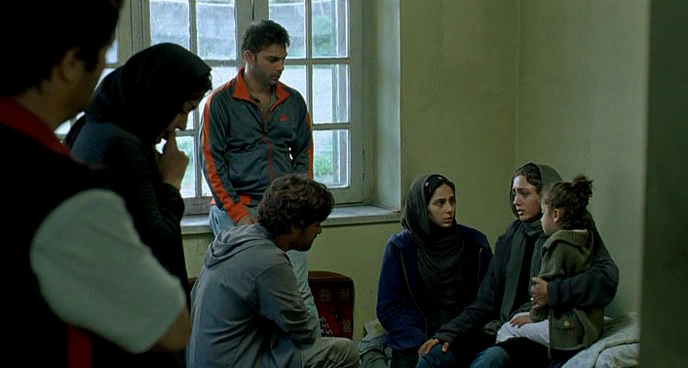
(Topmost) The group the day after the tragedy trying to figure out what happened. (Above) Sepideh reveals the truth to everyone.

Fargadi’s direction of the film is outstanding. I adore how he manages a total shift of tone atmosphere and how well he instructs every actors, especially the children. That ultimate scene which I guess lasted for more or less 20 minutes where the guys are trying to search and save the boy, while women shouting and cowering at the shore, then the others who went to the market came baffled with what is happening, then the boy was saved and now Elly is missing, and so on and so forth, is one powerful work of rigid direction, awesome acting by every single actors (that is without any exaggeration), exquisite editing, and a cinematography at top form. It is on that sequence though that I never got distracted by all the mid to fast tempo panning shots it required, instead I adore the camera movement applied on the sequence where the assumption of space is correlated with multi-character ostensive language of actions. That heck of a sequence is just the powder keg of the eventual and total unleashing of what the film is really made of.

“About Elly” interestingly delineates what people thinks about someone they don’t really know and there is surely no other better scenario to collate them than on a group of people who know each other very well. I am vainly intoxicated with the interaction occurring between these life long friends about thinking what is best, who is right, and how it happened. The emotional and moral make-up of each characters are so diverse that it structured a concerning storyline into a resonating and inescapable haunting of every human being equipped with the simple faculty of reacting. The film consistently keeps the upsurge of tension while it fleshes out and even debones every reasoning human being involved in the plot and finally unveils the mystery, and more importantly learns something that won’t be corrected—no matter how we want to tell the truth, there is a compelling and intangible force that won’t just allow us—and the reason behind it is not political at all. 

Tuesday, January 11, 2011

The King of Life

The World is Big and Salvation Lurks Around the Corner
Stefan Komandarev
Bulgaria
2009


How many films are out there that can actually make you feel thoroughly alive? To what extent should you consider yourself a film enthusiast and not doubt yourself in times that you think you’ve just found one of the best films in the world? This Bulgarian film, literally entitled as “The World is Big and Salvation Prowls on All Sides”, has granted a delightful caress on my heart and a staggering warmth to embrace my ideology which has believed in the enthrallment found after each man’s seemingly inconceivable journey for salvation on the face of a world stricken by pain and anguish. Komanderev’s debut narrative film is dowered by a captivating charm of images with terrific colors and frame composition and with the betrothing power of his connoisseur’s talent of storytelling.  The film is a celebration of life; and its howling convergence among the nostalgic past, the mundane present and a hopeful tomorrow. This short-listed movie for the 2009 Academy Awards Best Foreign Language Film category is a charismatic and beautiful motion picture that deserves every recognitions it has received in at least 17 International Awards; so bad though that Bulgaria just almost garnered its first ever nomination at the Oscar; I think the film is very much deserving for it. 

 
The story is told in two time frames: the present time is when Bai Dan went to a Germany to look after his grandson Sashko who is suffering from Amnesia after the car accident that killed his parents; and the past time is during Sashko’s childhood when he, together with his family escaped from Bulgaria to Germany. The second time frame is creatively used as the graphic visualizations of Bai Dan’s attempts to restitute his grandson’s memories. The result of this very resourceful narrative device is so commendable that it rendered an overwhelming quantity of the ineluctable relationship between the past and the present. There is a poignant scene in the first 30 minutes of the movie when Sashko is looking at the pictures his grandfather gave him. The editing intercut from Sashko’s close up shot showing tears rolling out of his eyes to a bedtime story moments of the young Sashko (him) and his mother telling the story of a lost rabbit seeking it way home.


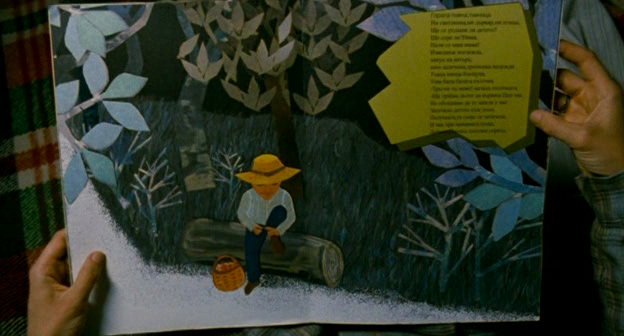
Before the complete intercut, another shot was necessary—an aerial low angle shot of Sashko sitting on a bench on the hospital’s moon-lit gardened; using graphical editing, it slowly crossfades to a baby rabbit sitting on an old dilapidated trunk on a moonlit woods from the storybook Sashko’s mother is was reading to him. 


The film went to back to Sashko at the present time, while his mother’s voice continues telling the story. As she says the lines about the mysterious path on the woods assuring the lost baby rabbit that it will take him home, Sashko starts to stand and walk along the path on the hospital garden, and thus, his journey home we all know is about to officially start. That scene is just one of the many scenes that have a compelling power that reunites the past and the present, the living and the deceased, and from there ventures into a time that is not the present nor the past anymore—the future, a time when the present and the past collides. 

Definitely a man-centered story, this film obviously defines the transition of a man; that is why the grandfather needed to have a grandson from his son. I appreciate the ambiguous reference of who-is-the-son-and-who-is-the-father in the first 15 minutes of the film. The second to the last part where Sashko is announced as the new king of backgammon in their locale after defeating his grandfather in a tie-breaker in a series of games, is the most efficient way to deliver the message that every man goes and every man comes. What is even more miraculous in this film is despite the fact that it is driven by male characters; I have never detected, not even half a minute of any hiatus interrupting the peaceful balance between men and women. Bai Dan and Sashko are not empowering women at all. They are indeed simple humans seeking for happiness and resolution without owning the power of its ability. Women in this film are equally are not plot-wise equally important, not even story-wise, but they provide salvation. To put this on another pedestal, this woman granting salvation does not bestow it heavenly, or as a God to an immortal. Instead, she also seeks salvation and happiness in return.

The Backgammon is another interesting part of the film. Apparent reasons for its contribution to the film would be life’s metaphor to a game; life is being played with destiny. The backgammon element also coheres to the rest of plot points, like the alleged selling of illegal backgammon boards causing Sashko’s father to be blackmailed by his communist boss to report anti-communist efforts of Bai Dan, the gradual lessons of Bai Dan and Sashko which intercepts with the gradual recovery of Sashko’s memory, and of course the initiation of the grandson to becoming one of the “men” through one of Bulgaria’s more famous pastime. 


A good the story is without a good narrative is forgivable, at least for me. Moreover, a good story with an outstanding narrative can never be an excellent film without technical competencies and I know for sure I am not the only one who believes in that. “The World is Big and Salvation Lurks Around the Corner” has certainly got all those important qualifications to becoming a very good film. Emil Hristow, the cinematographer has done an exquisitely wonderful visual interpretation of the screenplay. Since there are two distinguished time frames in the story, the difference in the treatment of the past and the present are also well identified. The past scenes have a very crisp, yellow-brownish, and thawed texture and colors as if every scene happened in one lovely lazy afternoon. I commend the realization that Hristow did not alter the treatment for the past scenes even when there are really shifts of eventual distress in the course of the escape. Soft shadows from the sun are always almost constant depicting the hope the film has started operating on our minds from its very opening and attempting to cushion the already obvious trouble. The cinematography endowed a dosage of beautiful nostalgia from the past.


The treatment for the present are dominated by cold colors—garish green and promising blue. Soft to almost hard shadows of the sun are still almost constant which creates a very luscious atmosphere. The present time treatment also gave way to even colder colors like gray, and a little touch of larky grounds and Bulgarian soil. The musical score has always been very helpful to any film. In this one, the opening scene alone that has a witty-paced whimsy beat mixed with Sashko’s soliloquy about his birth gave us the a mood that is at first feels very French, or at least European, and at most a mood that foretells the wit of the narrative course. 


With the dexterous eyes of Hristow and Komandarev, few remarkable scenes from the film made me feel so conscious of the mundanity of the present moment. As I have been mentioning all throughout, the beauty of the past and present and future are seamlessly conceived in the story and narrative, and furthermore been captured on screen, especially the present scenes. There are moments when Sashko and his grandfather simply sits on benches or old chairs, lies on the grass and talk, and with the appropriate composition, colors, and pace, those simple shots just became very detoxifying and at the same time sweetly intoxicating. The ultimate scene with such power that I can declare could be the one where Sashko and Maria are sitting on a boat dock; Maria lying on Sashko’s lap, plainly talking, with the out of focused lake waters at the background. Then it reminded me of a line I’ve seen on TV—“There is surely no other reason than the single purpose of the present moment”. 


Easy is to fall in love with a charmer film, but it takes an ingenuity and a truthful passion for life and films to create a deeply moving film that is not just simply a charmer. The film is teeming with life. It is simply intoxicating to watch a movie that has such an incredible respect for life, abundant sources to feel alive, and a hopeful heart to always begin a journey. The film is not a Utopian movie which would be a sorely pathetic attempt to create a beautiful film. What this film has is the acceptance of the life’s unavoidable loneliness and detriments and the more important thing is the belief that the world is big enough for salvation to bumble around everywhere; and while everybody believes that the world has been infected by selfishness and greed, this film has found a world where love is still plethoric.

Saturday, November 13, 2010

The Tough Guy Reinvention


Pulp Fiction
Quentin Tarantino
USA
1994


This Cannes Film Festival Golden Palm winner has probably been one of the most intelligent and notorious movies ever made to strike audiences from all around the planet since Tarantino introduced it. Honestly, I have never been excited to see the film. Based on most of hearsays, “Pulp Fiction” is a violent film highlighted by Tarantino’s wicked creativity. After seeing ‘Kill Bill 1 & 2”, which are my first two Tarantino films, I somewhat have deduced that “Pulp Fiction”-experience. This deduction though is definitely a sorely curtailed and unnecessary transgression of evaluating a film without actually seeing it; for “Pulp Fiction” is just an overwhelming cornucopia of originality, imagination, and fire! 


Aggression resulting to hostility and brutality driven by unjust motivations and/or unexpected obsessions contoured the silhouette of this appealing and edgy fiction. Despite these very unholy human idiosyncrasies engaging the main characters of the film, Tarantino had delineated his cleverness and originality by subtly channeling the characters from a series of worsening mishaps to the beginning of a tranquil redemption. Seeking salvation, consciously or not, in a world of drugs, guns, and fights sounds as helpless as impossible; however, this film shattered all clichés. What is even more commendable is the fact that all of the things most of the characters do are more likely unintentional. Butch (Bruce Willis) is the only protagonist who sturdily and consistently wanted to break up from Marsellus Wallace’s (Ving Rhames) gang from start to finish. Pitt (Samuel Jackson) certainly has the most highlighted emancipation, but he did not want it from start to finish. There had to be a miracle happen to him to realize that he wanted to stop his business with the gang. Vincent (John Travolta) did not have any redeeming moment in the story; however, the closest would be his desperate attempt to revive the cataleptic Mia (Uma Thurman). I believe that it is an exaggeration to label this brilliant film as happily ended, for likewise in fairy tales, a happy ended story needs the correction of everything. I commend Tarantino for not forcing any corrective measures to enunciate the presence of redemption. He only allowed rectifications and not correction because it takes a semi-God to eradicate such business. Moreover, the alterations detectable in the film are personal and not organizational or social. Butch had made a rectification when he went back to the basement, where Marsellus and he were held hostage, to save his boss who few minutes back was just trying to kill him. So Butch, instead of escaping his gangster boss and live his life in apprehension had managed to receive redemption from him and furthermore receive an implied absolution and signal to leave their business and go. 


I so fell in love with the sleepy and nostalgically colorful cinematography employed in the film. The soft lighting against the dominantly warm colored set and design creates memory-pinning images of the yesteryears. In case of bar scenes, where the set should be colder in color, the lighting still seldom uses hard lighting. The cinematography also uses a variety of colors to accentuate depth. Tim Burton films and “Pulp Fiction” can be both characterized by colorfulness and darkness, but Burton’s are dark, colorful, and bright, this one is dark, colorful, and squashy. Another element that contributed much to the vogue of the film is its hip musical score. These scores are not original; these are popular songs at least in the American pop culture. Assuming that using pop songs will degrade the authenticity of the film may be true in most cases but in this film, it is unnecessary. In fact, it has made the film more memory-pinning, trendy, and intelligently outstanding. The editing is competitive, though I wish I can say something else for that sounds definitely generic. It is hard to notice editing the first time you watch it, and this film has a non-linear storyline, compelling us to pay more attention to the corrects sequence rather than the shot to shot editing.


An unconventional storyline should possess a strong reason for doing so. Sean Penn’s “Into the Wild” had to tell the story in shuffled sequences because he wanted to match his protagonists’ adventures with the different stages of a man’s life—that is from infancy, to adolescence, and finally to adulthood. “500 Days of Summer” is probably the weakest non-linear edited story I have seen yet. “Pulp Fiction” though highly needed that technique. The movie had to start with the Bonnie and Clyde-like lovers planning to rob the restaurant where they were eating, and later reveal to be the exact place and time Vincent and Pitt were eating. The scene had to stop with the female robber pointing her guns while shouting and the next thing we saw was the comic-inspired OBB. It ended with the same scene; the only difference is that we already knew that Pitt and Vincent were also there. As mentioned, Pitt has the most highlighted redemption because it was positioned at the end and we usually remember endings. Aside from that, Pitt’s redemption is spiritual which takes everything into a deeper existential pedestal. Unlike Butch’s redemption which is a lover’s promise-driven one and inevitably commercial, Pitt’s salvation is more artistic and more complying to the artistry Tarantino is doing. The first and the last scene of the film, which is actually a single sequence, provided us with what we need to witness to identify character development. Knowing the reason behind Pitt’s Messianic predicament, permitted us to allow the complexity he is showing. Butch’s story is supposed to happen after that restaurant holdup, but his sequences were edited in the early to middle part of the film. One practical reason is that Butch is a main character and thus, his late appearance will cause disproportionate structure. The shambled sequences are not merely shambled without reasons, instead, it was used to solidify and cohere the many quirky elements of this fervid story into one flamboyant structure of one great film. 

 
Probably the best aspect in the film is the screenplay. The whimsicalities are so foxily planted; either within the character or within the plot. The stories told inside the film, or the rumors circulating among the introduced and unintroduced characters are not as necessary as it should be. It is forgivable though because those are as idiosyncratic as the dominating atmosphere throughout the film. One of my favorite told stories within the film is Mia’s experience as an actress in a pilot of a TV series. Mia was one of the Foxy Force Five, each has their own specialty; the blond one was the leader; the Japanese fox was a Kung Fu master; the black girl is the demolition expert; French fox’s specialty was sex; and she, was the expert with knives and knows a lot of old jokes because her grandfather was a vaudevillian. Moreover, the idea was that she will crack up one joke every episode, but they were never given another episode. Again, this is not really necessary, but it is amusing in that pop-culture-pinning way.  The passion for TV, music, and entertainment is always present in the atmosphere, which again makes the film hip! Another small quirky element in the film but has provided a clever irony is when Vince and Pitt are wearing shirts and shorts in the car and the restaurant. Big and tough gangster men can never be ridiculed enough than forcing them to wear shirts and shorts making them look like dorks.

“Pulp Fiction” is a scorching and ostentatious piece of artwork. Tarantino’s originality transcends in a profusion of transforming human wickedness in an extremely pleasurable and highly entertaining cinematic experience. The menacing colors of a film noir, the outrageous possibilities of what is next, and the undeniable force that compels viewers to be drawn are nothing but the niftiest of all the clever filmmakers I have ever witnessed.

Saturday, October 23, 2010

The Red Expression

Bad Education
Pedro Almodovar
Spain
2004
Pedro Almodovar, the world renowned feminist director, coming up with a queer film is nevertheless a brave statement about the integrity of women and the women-like men against the politically stronger sex—the male. This 2004 Spanish film is embroidered with the trademark Almodovar expression through red and other warm color-palette about unacceptable obsessions succumbing for at least recognition. Fantastic in most edges of a rubric-cube’s thriller, “Bad Education” is a flamboyant, unpredictable, and an original contemporary film.
Enrique (Felle Martinez) holds one of the most important elements in a thriller film—the POV. Despite that fact, interestingly Enrique is like a five year-old prince in the sense that his objective in the film is too sublime and seemingly too passive compared to the objectives of other major characters. This exclusivity in the POV of the film creates more suspense in the part of the audience for Enrique’s eyes are the viewer’s eyes as well. Unlike other thriller films whose main character or POV-holder do everything to seek for the reason behind the question, this case is just different. Enrique is a little appeased and a little ascertained to move the story. The force providing the thrill in the film is not provided by Enrique’s curiosity to solve the mystery instead by his reaction to the perseverance of the second character—Ignacio (Gael Garcia Bernal). Ignacio wants to play the role of Zahara, the drag queen in his play “The Visit” and obviously he is going to move heaven and earth just to get it. The aspiring actor never got the POV but he is more of the protagonist when it comes to drive to attain a certain goal while the POV-holder’s objectives are not even a quarter of Ignacio’s. The reason why this works is because of the fascinating dynamics between the two characters. Ignacio’s objective depends on Enrique’s decision and Enrique’s decisions are dependent on the past the two of them shared and the apprehension he is developing to his childhood friend. The objectives and conflicts in this film is overshadowed by the director’s style which is not a bad thing neither a disadvantage of any sort. This is definitely not a screenwriter’s film but definitely a director’s film more than anything else.   
This mere shot tells metaphors about the general scheme of the film: the distance between Enrique and Ignacio speaks about the many years they haven't heard of one another and its approaching infringe in the attempt to reviving the friendship and the sunlight on Enrique's side and its absence on Ignacio hints a secret the former doesn't know about the latter.
I am thinking too much about the development in the characters of “Bad Education” and at first I was saddened to figure out that it has been confined much to the suspense genre which equates character development to the mere fact of just knowing what happened. That is probably the weakest part of the film. While Almodovar utilizes the limitless opportunity of complexity in a story which provides quality revelations, the practicality of using what the protagonist would learn eventually in the course has been almost unavailable. I appreciate the deception in the storyline that as we are waiting to finally clarify our assumptions that young Enrique and Ignacio had really been sexually abused by Father Jacob in the orphanage, we are surprised that we never witnessed such scenes explicitly and instead we are taken to a different sub-story, a different pedestal of growing intensity and consequently curiosity.
A flashback scene of Ignacio and Father Jacob which will reveal as the exact scene from "The Visit" which Enrique will be directing.
High praises should be rendered to Almodovar’s use of creative devices. The quasi-flashback at the early minutes of the film juxtaposed with Enrique reading the script Ignacio wrote is trying to convince us that it is not just a mere thought or imagination but a picture of what these two childhood friends have undergone. The contribution of such device doesn’t end there, eventually we would be surprised that those actual sequences are the exact sequences in the film Enrique would be directing and Ignacio would be playing the drag role. This device is one of the most efficient and successful deceit I have seen yet. One of the things in the film that I spent conscious effort to trace its development is whether Ignacio will get the role or not, and I never thought that it has already been answered by that quasi-flashback mimicking foreshadowing with the fake Ignacio (played by Bernal) playing the drag queen character. This device also gives us a hint that the real Ignacio would be incisively like the gay character in “The Visit”. That originative manipulation comprised of reminiscing and fast forwarding at the utilitarian expense of stylized storytelling produced intelligent control over the rhythm of the narrative and that complexity resting on logical collectedness. Such single element at its disposal is automatically a bountiful of Almodovar legacy yet its individuality even raises the bar at the ether.
Probably the most striking shot in the film, the enclosed darkness predicts serious consequence to Ignacio, as Enrique (riding in the red car) learns about the secret.
Almodovar has always utilized scenes where a character or two reveal a secret from the past, and more often than not he opts to concentrate on that character telling the suddenly accessible information without any visual accompaniment. I can recall scenes from “To Return” and “All About my Mother” with such instances. This one however is a bit different, flashback scenes are required to be in the film when Father Jacob who is presently Mr Berenguer reveals how Ignacio died. Such flashback sequence is needed visually and is essential to the total coherence of the form because it is a supplement to the creative device mentioned above, and this time the information is coming from a different major character.  That supplement enables us to see how the real Ignacio looks like as supposed to the character Juan (Bernal) did everything to portray. The second device also counterpoises the balance between the character of the blundered Father Jacob and the untrustworthy Juan, and this time the fault-finding eye of Ignacio’s death looks sternly at Juan, more than Mr. Berenguer. This sequence requires us to be engaged more in a series of never-ending revelation and accusations.
 The first appearance of Gael Garcia Bernal as Juan and not as Juan pretending Ignacio. The way he looks so youthful is amazing. The ultra soft lighting, the unnoticeable make-up, and the clean shaved face all made him so youthful.
“Bad Education” is a brilliantly cinematographed film about fervid and clandestine obsessions at the height of religion, education, and socialization. As it speaks controversially, the film should be celebrated more of an artwork than a powder keg of social and religious revelations. The film is the film itself because the director made it his own; moreover, “Bad Education” is “Bad Education” because it is an Almodovar film more than anything else. Probably the drawback of an illustrious modern-day auteur, and the quagmire of a heavily stylized director is the criticism of the difficulty of these films to soar independently without the apparent strings of the creators’ minds. This contemporary Spanish film is undoubtedly adorable I just deeply feel that the director’s extreme ingenuity and expression in absolutely all of his works makes a dark, contentious, worldwide issue of morality a subordinate component of his work.

Saturday, October 2, 2010

One Right Too Few

Let the Right One In
Tomas Alfredson
Sweden
2004


This Norwegian vampire-drama film is an inconsistently outstanding film. Although most part of the film I find unnecessary there are also few remarkably fantastic scenes and elements, so good that it compensates the dragging feel of the whole story. Given the chance that it has been cut down to only 20-30% of the entire film, a short film in other words, then this film could have been perfect. Probably my main concern about this Alfredson movie is that the essence of the film is too scarcely found and evident that it gives such an exhausting demand from the viewers to make sense out of those arguably unimportant shots. On the brighter side, I can’t totally hate or dislike this film because it is not bad at all certainly. In fact, “Let the Right One In” happens to be in my Top 100 Movies at least because of those aforementioned fantastic scenes and elements.

One of the chief drawbacks about this film is in spite of having a close to stagnant plot; the story still relied on the plot to move the story. Thus, making a plot-driven movie out of a story that is almost plotless. That very action is nevertheless accountable for some amount of indulgence on something so mundane. Even at the end when we thought the vampire leaves the boy, and thought that the boy will start to fight back for the first time, he still did not and it has to be the vampire to reap the bodies of the boys bullying him. This is not my first time to see such unconventional approach on screenwriting and most of them are almost unforgivable for they are regarded as work of arts, or as original films, and yet you don’t feel it. This film however, is not bad, this is an exception indeed. 


Another drawback is the lack of tension appropriate for a vampire film. Though this is not purely a vampire film, there still has to be not just considerable but overflowing volume of tension. Yes there are those frightening scenes when Eli attacks humans, and when his father kills and drains the victim’s blood for her, but what is lacking is the tension from the community. I understand that there is a cultural difference between Philippine and Norwegian setting because a vampire film in the Philippines will surely have a tremendous tension contributed by the affected neighborhood or community, and that is something I did not feel even a little. There should be no excuse about how a neighborhood or community would react over vampires; it should be more or less just the same, culture therefore should not create less fear of vampires in one country with another country. I don’t understand why I never saw a police in this film. When people from the same community dies strangely how can there be no police investigating it? Why was there only a single person who tried to look for the culprit? Why was there no clamor from a cry-worthy event? These are narrative issues and there should be reasons definitely, however I can’t think of any reason that will justify the hassle of watching and understanding. Does Alfredson want to encircle the film just between Oskar and Eli? I don’t think that works. Vampires are folk-mythology, they can’t be too enclosed and they can’t be too personal.

We have some common understanding about the vampires: they are afraid intensely of the sunlight and may even burn; they are pale because they are not lit by sunshine and when they are hungry for blood; they look strange and awkward; they vomit human food (in our case—candy); and they have supernatural abilities of climbing and jumping. In this film though we learnt of new things about them: they are not cold at all like they can go out in the winter snow without having anything on their feet and any other gears to keep them warm; and that they have skills in solving a Rubik’s cube. The most important catch about vampires in this film is the fact that they can teach us some valuable lessons even though it is something violent—to fight back.


The story is not really focused about vampires, instead about a boy bullied at school and his unlikely friendship with a vampire and yet the vampire shares that spotlight with our main protagonist. Chiefly because there is no much power the protagonist holds that is why the vampire becomes a strong element. This reflects back to the flaw its narrative is ailing.

Mentioning that it is not bad at all despite of all the faultfinding I made, there are still a number of good things about this vampire-drama movie and some are very good. The last scene, which is the golden tooth in a mouth of decay, where Oskar still does not fight back against his classmates bestows and revives the age-long buried concept that human instincts still can’t kill, and when they can, one would be enough. Violence are only reduced to quirks as what I can see in this film and the only ones who hurt and kill are the non-human, a vampire, and any savage being. The actors are likeable it is actually keeping me from continuing watching. Though you are dissatisfied with most of the parts, it is always going to be hard to despise the film. Kare Hedebrant playing Oskar and Lina Leandersson playing Eli helped me get by. I find the film a little above average one. It has an independent film feel. Definitely not the tailor-cut, easy-to-watch movie, also the easy-to-find-fault one, and interestingly still-likeable, this film is really got me baffled not in how I understand the movie but in the sense that I don’t know why I hate it and yet I like it.

Friday, October 1, 2010

Jane the Champion

The Piano
Jane Campion
New Zealand
1993


The whole world has always wondered why great movies are directed by male directors, especially in Hollywood. In fact, Kathryn Bigelow has just been the first and only female director to win the Academy Award for Best Director after almost a century. However, I find Bigelow’s “The Hurt Locker” painful and inconsistently cooked, some parts are well-cooked, and others overcooked and mostly undercooked. This is not the first time that I’ve been disappointed with the hope of seeing a great movie from a female director though. Sofia Copolla’s “Lost in Translation” is completely unsatisfying at least for me. Not just that it is capriciously indulgent it is also uninspiring. I really did not see what other people and some of my colleagues saw with those two films. Traveling back 17 years from now, and a decade from those two failed attempts, Jane Campion has just shown the world and all women directors how to make a great, exuberant, rich film. With “The Piano” which won the prestigious Palm d’Or at the Cannes Film Festival, Campion proved to be one of the most important contemporary directors, and arguably the best among women directors.

Campion’s “The Piano” which is cinematographed by Stuart Dryburgh is intoxicatingly gorgeous. The photography is really stunning. I tried to scan the film and look at some opportune scenes. Every frame contains unbelievable amount of sultry and exciting passion. What is even more interesting and commendable about it is that even the temporal photography of the film is gorgeous. I am not inclined technically about music but the tempo of the film is just so powerful that even a relatively unknown man about music would notice rhythmic evidences in the film’s photography. The audio-visual treatment to this Victorian period film has nevertheless been fantastic. The cold and palette of colors compliments excellently the sober and mystical atmosphere needed in the story. Campion with the help of Dryburgh have successfully made the film flamboyantly cold.

I can compare the film to Wong Kar Wai’s “In the Mood for Love”, both are sexy and dazzling beautiful. The main difference though would be the colors. Kar Wai used saturated red-orange-black palette which conveniently delivered the heat of the repressed love affair in the story while Campion used dark blue and dark green with the eternal black and some other dark-cold colors. Between the two “In the Mood for Love” is more sentimentally-driven and delicate while “The Piano” is more ablaze and harsh therefore making me believe that between the two red-orange-black is an easier combination to portray the latter film. I find red a harsher color than dark blue and I find dark green more delicate than orange. Probably it is the culture of the country that resulted to those color decisions, but what I am trying to explain is that the combination Campion and Dryburgh chose is very interesting, intelligent, and edgy. Over-all, “The Piano” just knocked out the other.
 
The film is significantly semiotic. A lot of metaphors campaign over the almost two-hour movie. The environment of Ada’s new home: the agitated ocean, the serene shore, the uncongenial trees, and the despicable mud are all physical and logical metaphors of Ada’s own world clashing into the real world. Saving Ada from the cold and apathetic sea is also a symbol of her rebirth—a chance where she can leave all her sexual incompleteness and liberal control over her life. Ada’s shoe tying on the Piano after they drop it in the ocean symbolizes a part of her that will always be with her old Piano. The ultimate metaphor of course—the piano, is the metaphor of her life. This musical instrument is her voice. The piano allows her to release her feelings, anxieties, hopes, and most of all her silenced passion. I have a high regard for the scenes where Ada is playing and Baines is watching him. The music coming from the piano is the only essential sound occurring and those moments are so enchanting, almost heavenly. There is like an orbital of passion coming from Ada transported to the piano, and the piano diffuses it in the air through music, and Baines collect all those warm orbital of passion which sprees and fills his shabby hut. The piano allows us to know a character who can not speak, a device I’ve never yet seen used so charmingly.

Feminism is definitely the most apparent film theory we can apply in this Jane Campion movie and it is always interesting to create a feminist review of a film created by a woman. When most feminist films grab the opportunity to expose the interminable ego or the overrated evil of men, this film engages on the two sides of men—a technique to utilize the avoidance of feminine bias sometimes feminist fell into. The first type of men here is the one of Stewart (Sam Neill), the Englishman, who is educated, business-minded, and inevitably conformist. Those men treat their wives as properties and punish them whatever they feel like. Campion apparently made an effort to belittle that unpleasant side of men quality. At the beginning of Ada and her child’s stay at the place, Stewart even tries to project some fatherly gestures to Flora (Anna Paquin). The fact that he accepted Ada and her daughter even gave us a clue that those seemingly bad men are not bad at all and that Campion has no absolute negativities about that first type of men. The second type though would be that of George (Harvey Keitel), the native muscular guy, appealing, lover, and he who can make a woman happy. For the second type of man, I’ve seen any type of resentment embodied by George, no flaw and no loophole. In the circumstances where he can be a hero, Campion either cuts the scene or use a child to stop him. In a scene where Stewart goes into George’s hut we are all surprised to see that George is alive and Stewart is out of the picture. This obviously implies that former have either accidentally or purposefully killed latter. That scene is cut because it will certainly mark George as the hero and Stewart the bad guy (after cutting Ada’s finger) who has to be punished. The role of men in “The Piano” is not pretentious, no strong opinion instead a closer opinion most people with fair understanding might agree with.


Acting-wise, Holly Hunter is phenomenal winning the Best Actress award at the 1993 Academy Awards. I love the awkwardness and all the other element of mystery and strangeness she contains. She is radiating with pale yet dynamic aura like she is a gritty and quirky Mona Lisa or something. Hunter doesn’t just use her face to compensate for her verbal restraints rather she used her face and body. The pauses she makes after moving and the way she directs her eyes to a co-actor and they way she redirects them are so divine, so fluid, done like a real Victorian-era woman. The young Anna Paquin though is the apple of my eye also winning in the 1993 Oscar Awards winning the Best Supporting Actress award. She has brought overwhelming innocent, playful, and youthful energy in the entire film. Her ostentatiously loud charisma compliments Hunter’s mystifying silent aura. Paquin definitely is one of the best child stars I’ve ever seen grown in Hollywood. She is on par with Haley Joel Osment when he impressed the world in M. Night Shyamalan’s “The Sixth Sense”.

“The Piano” is a film that has an interesting story and staggeringly dexterous direction. Campion has chosen an impeccable period to tell a story of a mute female pianist, a breathtaking landscape to provide the artistic interpretation of her story, and a satisfying ensemble to give life to her lovely characters. This Cannes-winning film is not angry in the backdrop of identifiable tensions and violence; instead it continues to be vigilant inside. I admire Campion because she knows what to show and what to cut, she did not cut the scene where Ada lost her finger because that allows us to see Stewart’s power over Ada, her helplessness, her possible incapacity to play the piano anymore, and most importantly the mean side of Stewart, for us to have a catch of the bad guy. Jane Campion needs to do more films. I never thought she is as good as this.

Wednesday, September 29, 2010

The List of Life

Schindler’s List
Steven Spielberg
USA
1993


Just when I thought I will never see a film more passionate and more beautiful than my long time Italian classic favorite “The Bicycle Thief”, this 1993 Academy Award Best Picture winner struck me like a lightning of humanity at its purest, tore my heart relentlessly nearly close to the sorrow thousands and millions of aggravated, humiliated, and profaned Jews experienced, and most importantly moved me in a place where questions about life and its importance, ironies, ambiguities, and catastrophic evil are constantly breathing intemperately. There have been a lot of films that made me misty eyed, also a number of films that made me cry, but “Schindler’s List” just has been so far the only film I found myself bursting in tears I never thought I contain. The equation of material things like car, watch, and a pin of gold and of a thing as simple yet as complicated like life made me feel that it is extremely unacceptable. In fact, to even think of these money and material possessions as a replacement to or something more important than life is sick and evil. The world has been so intellectual yet decadent and educated yet so greedy. Power seekers in order to be what they want needs to blind and so they become blind, not of their historical goals but of the simpler things like the life of many ordinary people.  The world honestly is gruesomely consumed by the doom of ravenousness and constant ignorance of harmony and humanity. Never in my life though I have believed that we will ever become the absolute peaceful world, the idea is so beautifully Utopian and it is never a characteristic of this planet and so the closest thing that we can do is to minimize chaos and maximize peace. The founding of United Nations is one my favorite historical point in our history.

Now, what made me abhor this never-ending asymmetrical relations of the powerful and the powerless and the conventionalized sacrifice of many else’s life for the power-seekers when from the start I know it is an incurable plague? I can’t be any more satisfied and inspired to that brilliance exceptionally delivered by Steven Spielberg—a director I first considered seriously good in the nostalgic “Artificial Intelligence” (with my favorite child actor ever—Haley Joel Osment), and then I admired in the groundbreaking “Saving Private Ryan” (with the Hollywood Apple of my eye—Tom Hanks), and now I adore in my favorite film of all time and all nation—“Schindler’s List”. The amount of wonder Spielberg added in the film is unthinkably great. After hearing a lot of stories from his grandparents, and some friends and acquaintances who have experienced the wrath of the Second World War, he conducted ardent research about the Jew survivors of the Holocaust that until now continues as he founded the Shoah--a visual library where all the conducted interviews of all living Jews retell the painful and harrowing experiences. The setting, the Jews of the 2nd World War or the Hitler War as I am fond of substituting, is the best backdrop any storyteller can choose or have if you want to feel the spirit of life in its most unadulterated anatomy. These aggravated people of Jews forced to surrender their businesses and lands, robbed of their properties, detested in front of fellowmen, and scorned by (at least) the Nazis, perhaps alongside with soldiers at war, have brought forth the most exceptional amount of empathy I can manage to produce. Even with their seeming passivity, their downright hope and desire to survive with their family and loved ones definitely deserves respect. Their eventual inhumane and unnecessary death makes reviewing what the world provided them really painful and poignant. The cause of their horrifying death doesn’t cease with the end of the war which makes things very disturbing and worrying because the cause is nothing more or less than discrimination and it still plagues our society, and it may happen again. 


Spielberg makes Oskar Schindler (Liam Neeson) the absolutely perfect imperfect man to save 1,100 Jewish lives and to learn one of the greatest lessons ever covered in films. Schindler is a war profiteer, when the Nazis ruled Poland, they confiscated all Jew-operated and owned businesses. Being the wise man, he convinced the Jew owners of these businesses to transfer everything to his name thus making it a legal German-owned company. With the help of the accountant and a Jew Izthak Stern (Ben Kingsley) and Jewish working for the cheapest rates, Schindler makes more money than any man can ever live luxuriously for the rest of his life. If there is one thing that really made me emotionally and spiritually connected to this black and white film is its premise of money buying people and gold buying ideology. As of now I can’t think of any other as inappropriate yet dramatically striking irony in life than life and money, life and death is not even half of it. Schindler is able to send some Jews from other concentration camp to his factory and route trainload of Jews instead of transporting them to some other camps through bribing. It is not a rocket science; the more Schindler can bribe the captain of a camp, the more people he can get for his factory. At first, he wants Jews to work because their labor is too cheap that you don’t even feel you’re paying them but before the transfer to Auschwitz, he then wants more and more Jews in his factory not to earn anymore but to save lives. Schindler’s list is the list of life, it’s allegory to the book of life is wonderful. The transition between Schindler the businessman and Schindler the savior is ambiguous when I think it should be distinct. However, t is not a drawback at any serious ways instead it only interprets how discreet one German should be in sympathizing with the Jews.

One of my favorite scenes is when Schindler welcomes the male Jews off the train from the old camp to his new factory and said something like—“…inside are bread and hot soup waiting for everybody.” I will cry with those words if I am one of those Jews who wake up every morning to spend the rest of his day working harder than any animal while waiting for arrant Nazis to shoot him to his death. That bread and hot soup is not simply bread and a hot soup but words that will promise them that there is hope for them to live again like human beings. That factory is a sanctuary, the safest place for any Jew, and it is so overwhelming that those thousands of lives depends on one, only one person, and his money. While the train of the male Jews are safely routed to Auschwitz, the train where the female ones are ridden for some mistake have been transported to a different camp where sure they will die after some time. Stern tells Schindler about the error, and the lives of hundreds of Jew women and children, in a matter of hours or minutes, will either be saved or perished.

 
The ultimate best scene in the film and perhaps of all scenes from films I’ve ever seen is the long sequence at the end of “Schindler’s List”. The war ended and Schindler being a German needs to escape in that absolved factory, before he would take his car Stern and several other Jews melted a gold tooth and mold it into a ring with inscriptions saying—one who saves one life saves the world entire. His workers also make a letter explaining Schindler’s unbelievable predicament to the Jews in case he get caught, and every single Jews in the factory signed it. Schindler starts to cry saying he did not do enough. Stern consoles the man he has always seen the goodness even from the start asking him to look at those over a thousand he has saved. It wasn’t enough for Schindler, he wasted so much money before for wines, women, and good and sinful times, when all those money could have doubled the numbers of Jews who could have survived the war. He starts to begrudge at his car, saying that it could have saved ten more people and even at his Swastika gold pin which could be used as a bribe for at least one more life. Schindler bursts into tears as his people around try to hug him and comfort him, as the simplest way to thank him for letting them live the greatest gift the Lord gave us—life. As I break into tears alongside this cinema’s and history’s significant moment many thoughts outpours in my head, most of them I mentioned in the first paragraph but what makes me weak is that people will still continue to kill people for reasons conscious or unconscious, the Turkish film “I Saw the Sun” made me realize that. But as the film suggests, anyone can still do something, a change, a change that may no be perfect, universal, and absolute. We are not God to completely change the world, but we do have our spaces in this world, and there are people in the proximities of our hearts, our aspirations, and soul. No matter how small that change was for as long as it benefited even a single person provided with the purest intentions then the Jewish proverb—“one who saves one life saves the world entire”, will be our friend.

Adolf Hitler is the main and the most obvious culprit in this one of the history’s most dreadful and atrocious period in our world. The 2004 German film “Downfall” allowed me to reserve certain respect for this man they call the 2nd Anti-Christ. For how monstrous he had done in our history, he was still a man, almost like a God the German nation trusted. Watching “Schindler’s List” doesn’t make me utterly hate Hitler after all. As a disclaimer, it is unsatisfying to learn that there is no accurate and absolute studies about the reasons why Hitler hated the Jews. Therefore while Hitler may have hated and wanted to eradicate the descendants of Jacob, I have to agree with some studies believing that the world have their own different share of this consummate hatred. Hitler is just one of those who hates even before he became Fuhrer of the German nation. Hitler was not the only one, all the people who are bigots, hypocrite, envious, narcissists, and ignorant are the real murderers. As I mentioned earlier, these different figures of evil have not been buried with the millions of body-casualties and this evil in the form of discrimination will still haunt millions of lives today and in the following generations to come.

I can’t thank the Lord well enough for destining me to witness this purifying film I now officially declare as my #1 in my Top 100 Films of all Time and Nation, Steven Spielberg and every single names in the credits of the film for producing a life-changing poignant work of art and history, the Video City near our house where I rented this DVD which even though I paid for a day of penalty is still worthy and even worthier than all of the movies I ever rented there combined, and all of the universe conspiring for this one in a million cinematic experience emblazoned in my heart and soul. More people should see this heart-rending, soul-breaking, moral-provoking black and white Holocaust masterpiece. “Schindler’s List” proves Hollywood’s undeniable power and influence and Spielberg demonstrates the universality of human experience. You don’t have to be a Jew yourself and you don’t have to have a family thrown at Kraskow ghettos, all you need to have is the heart for all the hundreds of thousand of Jews massacred in the Hitler War and some swamping deluge of cinematic talent of course. The frame by frame shots, composition, black and white contrast, simple camera movement, adept film editing, excellent sound design, and touching score still put this film in a heavenly pedestal. This movie simply made me so proud about my passion and enthusiasm for films.